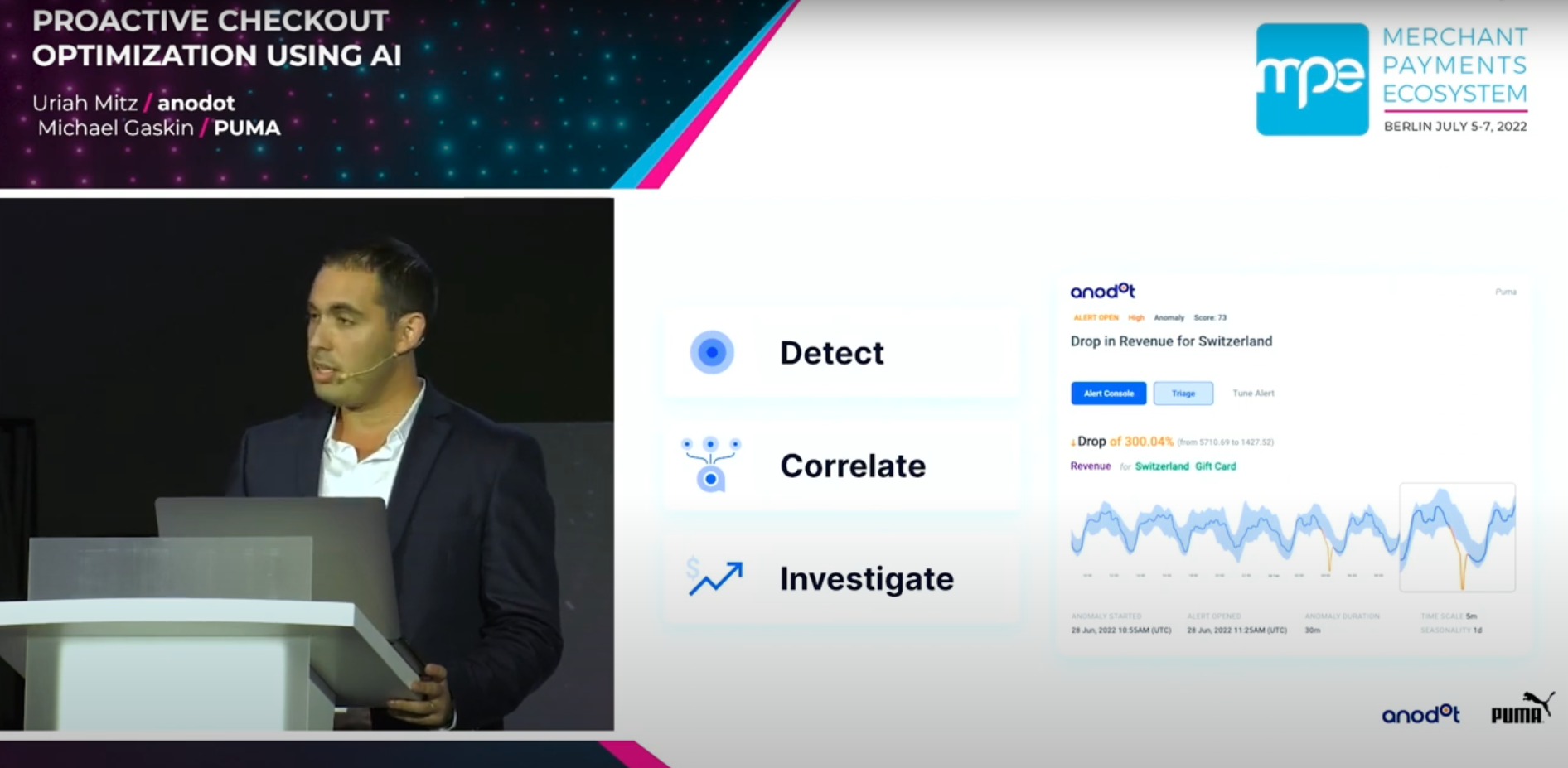
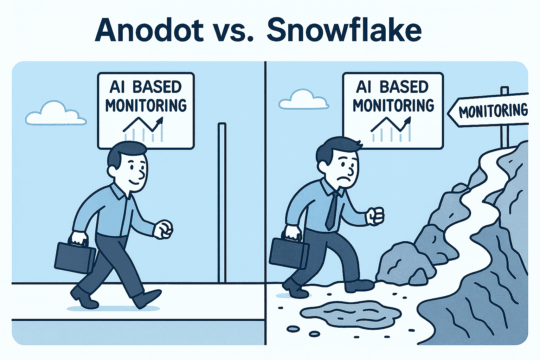
Anodot vs. Snowflake DIY Anomaly Detection based Monitoring
Audience: Data, Risk, and Product leaders evaluating anomaly detection for revenue protection
 TL;DR
TL;DR
 TL;DR
TL;DR - Anodot delivers higher‑quality, lower‑noise anomaly detection at enterprise scale with correlation, significance scoring, and incident UX out‑of‑the‑box.
- Snowflake‑built solutions can work for simple single‑metric checks or when you want full custom control, but they require significant engineering and ongoing maintenance.
What “quality of monitoring” means
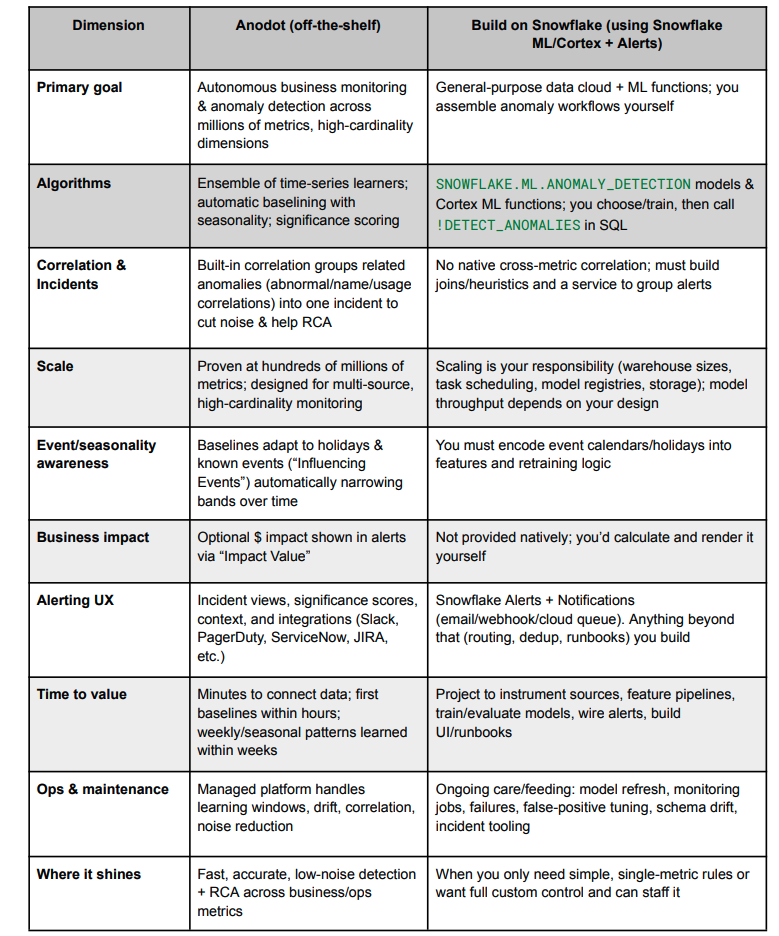
- Signal vs. noise: Anodot groups related anomalies into a single incident and ranks by significance; Snowflake functions flag anomalies but you must build correlation/dedup logic.
- Seasonality & events: Anodot learns hourly/daily/weekly baselines and incorporates holidays/ promotions; in Snowflake you must engineer features (calendars, promotions) and retraining.
- Context & RCA: Anodot provides incident views with dimensions and contributing factors; Snowflake requires you to build joins, dashboards, and triage UX (e.g., Streamlit/SiS).
Head‑to‑head summary
Fintech revenue‑protection examples (Anodot)
1) Payments authorization drop
Signal: 12% YoY dip in approval rate for BINs tied to Region X from 09:00–11:00.
Correlation: Concurrent spike in 3DS challenge rates + gateway timeouts.
Outcome: Single incident auto‑routed; impact estimate: −$425k projected daily revenue if unresolved.
2) Card funding/Top‑up latency
Signal: P95 latency for bank‑transfer top‑ups exceeds learned band only for a specific PSP + currency. Correlation: Queue backlog anomalies on the ETL path feeding the ledger table.
Outcome: Ops and PSP team paged once (not 20 times); customer‑visible incidents prevented.
3) Chargeback anomaly by merchant cluster
Signal: Standardized residuals on chargeback rate spike for mid‑risk MCC cluster.
Correlation: Marketing campaign event overlay + new fraud‑model rollout window. Outcome: Rapid root cause isolation, campaign throttled, fraud rules adjusted.
In each case, Anodot: (a) learns normal per segment, (b) correlates co‑moving metrics, (c) provides incident context + optional $‑impact.
Time to value
- Anodot: Connect Snowflake (and other sources), auto‑discover metrics/dimensions, begin baselining; first useful alerts typically within hours/days.
- Snowflake build: Data modeling → feature pipelines → model creation
( SNOWFLAKE.ML.ANOMALY_DETECTION ) → inference jobs → alerting → triage UX. Expect weeks before wide coverage; months to reach parity on correlation/noise reduction.
Maintenance & ownership
- Anodot: Managed model lifecycle (seasonality, drift), correlation tuning, noise reduction, integrations (Slack, PagerDuty, ServiceNow, JIRA, Opsgenie).
- Snowflake build: You own tasks, warehouse sizing, model retraining cadence, schema drift handling, dedup/aggregation logic, UI, on‑call for failures.
Capabilities you don’t get “for free” in Snowflake
- Cross‑metric correlation & incident grouping
- Significance scoring to prioritize
- Holiday/event‑aware baselines (“influencing events”)
- Built‑in $‑impact estimation
- Incident UX out‑of‑the‑box with deep integrations
When a Snowflake‑native build can make sense
- Narrow scope (few metrics), simple thresholds. •
Strong need for fully custom logic with a staffed ML/platform team. •
Strict data‑residency constraints and acceptance of the engineering investment. Architecture options
- Hybrid (recommended for Snowflake‑first teams): Keep data in Snowflake; connect Anodot for
detection/correlation; send incidents to Slack/PagerDuty/ServiceNow. Minimal data movement, fastest value.
Anodot
- Product overview & anomaly detection: https://www.anodot.com/platform/
- Correlation & incidents: https://www.anodot.com/product/anomaly-detection/
- Business impact (Impact Value) & event awareness: https://www.anodot.com/product/business monitoring/
- Snowflake connector & integrations: https://www.anodot.com/integrations/snowflake/
Snowflake
- Snowflake ML Anomaly Detection (SQL): https://docs.snowflake.com/en/user-guide/snowflake-ml/ anomaly-detection
- Cortex ML functions overview: https://docs.snowflake.com/en/user-guide/snowflake-cortex/ • Alerts & Notifications: https://docs.snowflake.com/en/user-guide/alerts
- Tasks & scheduling: https://docs.snowflake.com/en/user-guide/tasks
- Streamlit in Snowflake (incident/triage UI option): https://docs.snowflake.com/en/user-guide/ui-streamlit
Recommendation: For broad, low‑noise fintech revenue protection with quick ROI and minimal upkeep, adopt Anodot—optionally via the hybrid pattern to keep Snowflake at the core.